


Introduction
This is an online, synchronous, multiplayer, business concept simulation game. It is designed to be played by between 8-10 people and gameplay typically lasts one hour. The game can be enjoyably played a number of times by the same player(s).
The game is relatively simple to learn and play, however, this is not a complete business simulation, it does not seek to allow players to simulate all aspects of new venture creation.
The game does focus on certain key concepts in new venture development, some of these are as follows:
1. Entrepreneurs can choose how risky their ventures will be
2. Entrepreneurs may need to take into account the wider environment when they make business decisions
3. Risk-taking can involve getting other people to trust you (in the context of this game, investors).
How do you win?
Players aim to make as much money as possible, for themselves.
The game
There are two groups of players in the game. Investors who have $100 each and entrepreneurs who each have 100% ownership of businesses that they are setting up.
There is only one decision entrepreneurs need to make, how risky do they want their businesses to be?
The greater the risk, the greater the potential reward for them and their investors.
But also the greater the chance of failure and total loss for themselves and their investors.
Investors choose how much risk they want to take - this determines the order in which they see entrepreneurs.
Choosing reward and risk
Entrepreneurs choose any number from 1 to 5 to select how much reward & risk they want their venture to have.
If they select 1, they will need to raise $50 in order for the venture to succeed. And if they raise $50 or more, the amount raised will be multiplied by 10%.
The entrepreneur will share the gain according to how much of their venture they kept and gave away to investors.

The challenges for entrepreneurs
The challenges for investors
1. Set a level of risk preference that will allow them to win the game
2. Negotiating a high level of equity from an entrepreneur is fine - but will that leave the entrepreneur with enough equity to attract other investors?
3. Risk may be managed by spreading investments across a number of different entrepreneurs, but will that mean none of them will reach their target?
Deciding how to negotiate
1. Entrepreneurs can choose a level of risk for their venture and this affects how much reward the venture can generate.
2. This has implications for the minimum amounts of equity that investors should look for when they invest in a venture.
3. The table below illustrates this. For example if an entrepreneur has selected 2 as the level of risk, they will need to raise $70 and if they do this the total amount invested will be multiplied by 2.
From this we can calculate that as a group investors will need to receive a 50% stake in this venture if they are to simply recoup their investment (without making any additional gain).
Any individual investor will need to get 0.71% of the venture for every $1 invested or 3.5% for every $5 invested and so on.
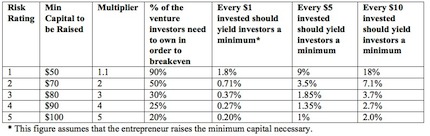
Of course given the risks involved investors will want more than the percentages shown above, which represent the absolute minimum investors should look for.
The negotiation
In a game there are 2 rounds. In each round each entrepreneur sees each investor once in order to negotiate how much equity the investor will receive for their investment. The two players can also chat using text.